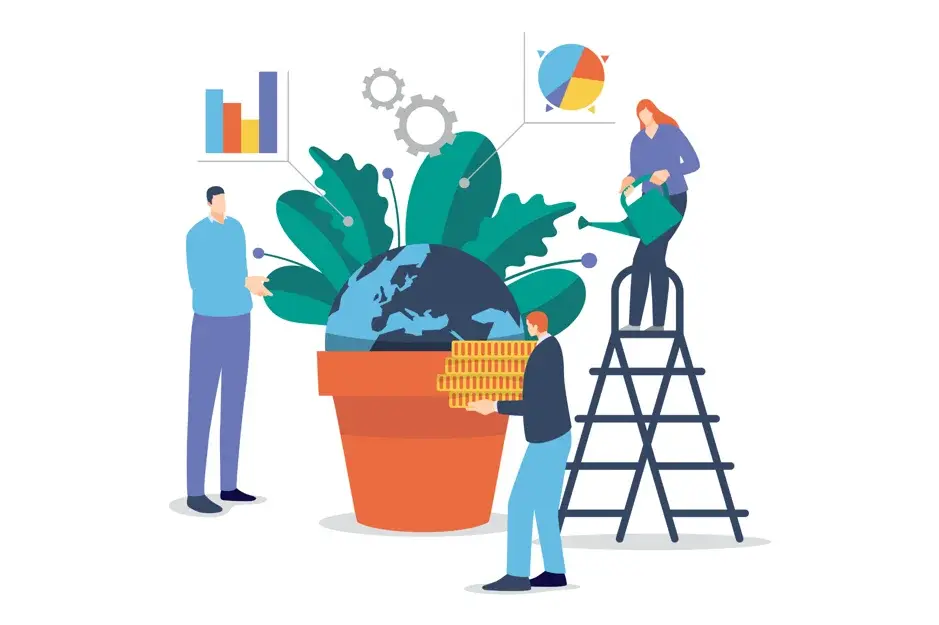
Today the word "ecosystem" turns out to be somewhat abused, especially when linked to the corporate structure, but that is not to say that it is incorrect; more than that, it is too often deprived of its real value.
We can therefore try to rehabilitate this word, giving it a meaning again in relation, above all, to a way of doing Welfare that is really part of the corporate fabric: not simply anadd-on, but a foundation ofcorporate culture.
So let us try to understand together why for Epassi a Welfare that is silent, but always present and aimed at ensuring an environment in which to feel good and open to dialogue, is so fundamental.
A business ecosystem
Anecosystem in nature is a collection of living organisms (such as plants, animals and microorganisms), which interact both with each other and with the surrounding environment (air, water, soil), thus forming an interconnected, complex and interdependent system.
In other words, the elements of an ecosystem depend on each other, both to survive and to be able to grow and thrive.
These interactions can be of various types: food, physical, chemical, or other, and are critical to maintaining the balance and health of the ecosystem itself.
When we talk about abusiness ecosystem, we refer to a similar concept, but applied to the world of work and business, referring either toforms of "external" ties, aimed at creating anetwork of actors (companies, partners, suppliers, customers, investors, public agencies, etc.) that interact with each other in various ways, each providing different skills to create economic value and innovation, or in reference tothe internal soul of the company itself.
We will focus today mainly on the latter.
Parallels between natural ecosystem and business ecosystem
The term"business ecosystem " or " enterprise ecosystem " refers to the interaction and connection between all the resources, departments, functions and people that make up a company.
These elements should be interdependent and work together toachieve common goals, such as growth, efficiency and innovation.
In a business ecosystem, the different job functions (e.g. marketing department, human resources, production chain, sales department, research and development...) work closely together, like organisms in a natural ecosystem, and are inseparable from each other.
Each department-or professional figure-contributes its specific role, creating an interconnected and synergistic work environmentwith real evolutionary possibilities.
As we said, the term "ecosystem" is often abused as an epithet for a modern, living company, but - rarely - do the companies that are bestowed with this definition really meet the requirements to be such.
Let's look at some key points, which underlie the parallelism
1. Interconnectedness and interdependence
In nature, living organisms are linked by complex relationships of symbiosis, predation and cooperation, which promote mutual survival.
Similarly, within a company, different operational teams are interconnected and depend on each other. For example, the marketing department depends on information provided by research and development to promote products, while production needs sales to guide the production of goods demanded by the market.
2. Dynamic balance
Natural ecosystems adapt and maintain a balance among different species so as to ensure the survival of all organisms involved, without one being more valuable than the other.
Even in a business, it is essential that each function or department work in a balanced and interdependent way. If one department is inefficient or isolated, it can undermine the functioning of the entire system. For example, a shortage in human resources can slow innovation in technical departments or sales. But-mostimportantly-every WORKER must feel good in the company, and it is therefore necessary to cultivate everyone's mental and physical well-being (by analyzing subjective needs), to ensure overall well-being and prosperity, both in terms of quality and productivity.
3. Evolution and adaptation
Natural ecosystems continually evolve to respond to the ever-changing environment around them (climate, new species, etc.).
Similarly, an internal business ecosystem must be able toadapt to changes in the market, technologies and consumer expectations, but also to the individual needs of its employees. Needs in turn influenced by external geopolitical and historical conditions, as well as by home culture, society and individual family dynamics. Each company must therefore be ready to evolve and shape itself, to meet new needs, with a focus on innovation and continuous improvement.
4. Shared resources
In nature, natural resources such as water, sunlight and nutrients are equally shared among all species in the ecosystem.
Within a company, resources such as time, information, skills, and technology are shared among departments. Managing these resources efficiently and collaboratively allows the entire company to grow and prosper. Providingfair opportunities for growth and constant refresher courses is also critical, to keep the company at a competitive level.
In light of this simple parallel,does it still make sense to define a healthy company and a happy work environment as an "ecosystem"?
In our view, yes, but this is precisely where the crucial role of Corporate Welfare, as we see it at Eudaimon, comes into play.
The role of Corporate Welfare in creating a business ecosystem
CorporateWelfare is a key element that contributes to the smooth functioning of the internal business ecosystem, improving the well-being, motivation and productivity of employees.
Just as in a natural ecosystem, where the well-being of organisms is essential to maintain balance, a healthy and stimulating work environment in fact also promotes collective success.
Including initiatives such as health programs, psychological support, continuing education, work flexibility and economic incentives, all designed to meet the physical, emotional and professional needs of employees.
When employees are supported and valued, they contribute more efficiently and creatively to the company's progress, but-as we have discussed in more detail HERE-what the company does in good faith to promote the well-being of its employees does not always coincide with the actual needs of individual workers.
So before we figure out what to do, let's start with why to do it.
The benefits of viewing the company as an "ecosystem"
-
Increased retention and attraction of talent. Good corporate welfare makes the company a desirable place to work, increasing employee retention and attracting qualified talent.
-
Improved business climate. Employees' mental and physical well-being positively affects internal relations, creating a more harmonious, collaborative and conflict-free work environment.
-
Increased productivity. Investing in Corporate Welfare means reducing absenteeism and improving employee motivation and engagement, with a direct impact on employee productivity.
-
Sustainability and internal responsibility. Promoting Corporate Welfare demonstrates the company's commitment to its employees, strengthening its internal reputation and creating a bond of trust between workers and management.
It is therefore clear how Welfare is not reducible to a simple set of benefits, but requires a strategic component, to create a corporate ecosystem that fosters cohesion, motivation and sustainable growth within the company itself.
Companies that invest in the well-being of their employees are better prepared to respond to market challenges and achieve lasting results over time.
Summing up then,to truly value the concept of the company as an ecosystem, what needs to be invested in?
Welfare according to Eudaimon
Corporate Welfare that can truly generate a healthy and just business ecosystem must besilent!
It might be counterintuitive, but a constant presence, invading every sphere of corporate life and culture, ends up not even being perceptible, because it integrates so naturally and casually into the corporate landscape, that any evidence of it would almost be an excess.
The personalization of Welfare and thus of the services and supports offered no longer allows for the selection of a one-size-fits-all bonus package, but requires more and more attention and, above all, interpersonal and empathic dialogue to understand what each person needs and what he or she does not.
Recommended readings:
Corporate Welfare in Europe and the Winning Trend of Personalization.
The Importance of Corporate Welfare Communication.
Welfare is an integral part of corporate culture, if not - even - its ultimate expression! What the company is and communicates comes through its practical actions and internal initiatives.
The presentation of the work environment as a "welfare hub" becomes even more important, in a society that is increasingly aiming - not only atWork Life Balance - but at theLife Work Blend.
Work-related stress: there is a need for more well-being in the company!
The well-being of all components of the ecosystem is inescapable for the overall health of the system itself, soa good Welfare plan must be able to accommodate everyone's needs and , to do so, there is no one-size-fits-all rule: empathy, survey, dynamism, flexibility and adaptability are the only winning weapons.